
Palabras clave
Reactividad cruzada
Anticuerpos IgE
Ácaros
Mohos
Bioinformática
Cómo citar
Resumen
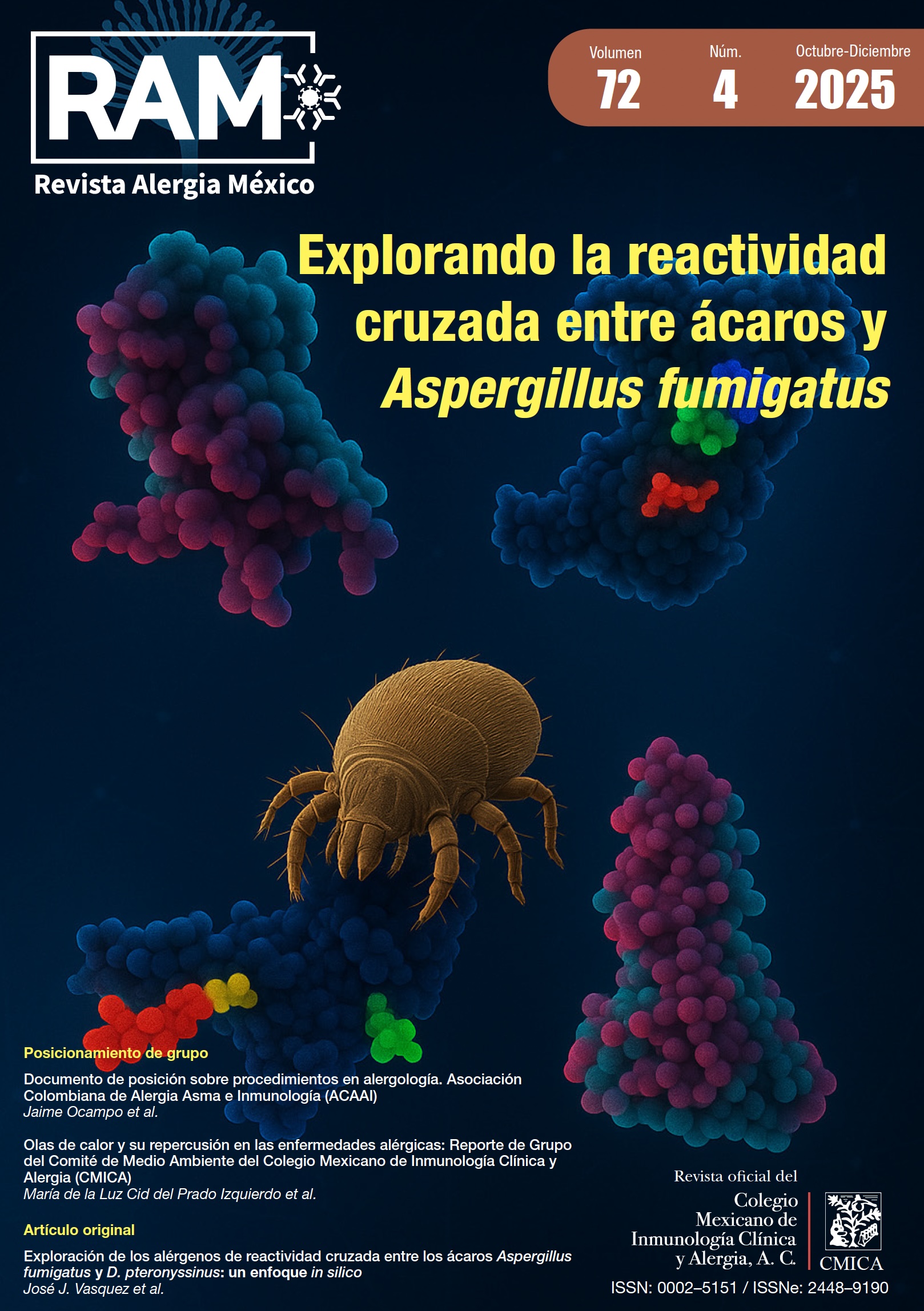
Objetivo: Examinar la posible reactividad cruzada entre A. fumigatus y los ácaros, ambas importantes fuentes de alérgenos en regiones tropicales, mediante un enfoque bioinformático.
Métodos: Se recuperaron las secuencias de aminoácidos de alérgenos de Aspergillus fumigatus registradas en la base de datos del alergoma y se utilizaron como entrada para realizar un análisis PSI-BLAST contra el proteoma de Dermatophagoides pteronyssinus. Se seleccionaron para su posterior análisis los resultados con similitudes y valores de cobertura de consulta superiores al 25 y al 80%, respectivamente. La predicción de epítopos de células B se realizó mediante la herramienta Ellipro. Solo se identificaron los epítopos conservados entre ambas fuentes alergénicas y se visualizaron en superficies de modelos 3D obtenidas mediante modelado basado en homología.
Resultados: Doce alérgenos de Aspergillus fumigatus compartieron homología con proteínas descritas en D. pteronyssinus. Todos los modelos 3D obtenidos mostraron el plegamiento típico de la familia proteica a la que pertenecen. La proteína ribosomal L3, la chaperona molecular Mod-E/Hsp90, la proteína ribosomal ácida P2, la enolasa y la peptidil-propil cis-trans-isomerasa fueron los alérgenos con mayor puntuación de identidad (>60%). Se predijo que al menos cuatro epítopos lineales B eran compartidos entre los alérgenos y homólogos en D. pteronyssinus
Referencias
1. Schwienbacher M, Israel L, Heesemann J, Ebel F. Asp f6, an Aspergillus allergen specifically recognized by IgE from patients with allergic bronchopulmonary aspergillosis, is differentially expressed during germination. Allergy 2005; 60 (11): 1430-5.
2. Acevedo N, Sánchez J, Zakzuk J, Bornacelly A, et al. Particular characteristics of allergic symptoms in tropical environments: follow up to 24 months in the FRAAT birth cohort study. BMC Pulm Med 2012; 12: 13.
3. Goh KJ, Yii ACA, Lapperre TS, Chan AK, et al. Sensitization to Aspergillus species is associated with frequent exacerbations in severe asthma. J Asthma Allergy 2017; 10: 131-40.
4. Sio YY, Pang SL, Say YH, Teh KF, et al. Sensitization to Airborne Fungal Allergens Associates with Asthma and Allergic Rhinitis Presentation and Severity in the Singaporean/Malaysian Population. Mycopathologia 2021; 186 (5): 583-8.
5. Herrera BO PR, Rodríguez CJS. Cutaneous sensibility to environments fungus and nasal mycobiota study in respiratory allergic patients. Invest Medicoquir 2019; 11 (2).
6. Celakovska J, Vankova R, Bukac J, Cermakova E, et al. Atopic Dermatitis and Sensitisation to Molecular Components of Alternaria, Cladosporium, Penicillium, Aspergillus, and Malassezia-Results of Allergy Explorer ALEX 2. J Fungi (Basel) 2021; 7 (3).
7. Roesner LM, Werfel T. Autoimmunity (or Not) in Atopic Dermatitis. Front Immunol 2019; 10: 2128.
8. Mirabi A, Golpour M, Mirabi R. Aspergillus Species and House Dust Mites: Their Allergenicity and Contribution: A Review Article. Int J Med Rev 2018; 5 (2): 55-9.
9. Glaser AG, Menz G, Kirsch AI, Zeller S, et al. Auto- and cross-reactivity to thioredoxin allergens in allergic bronchopulmonary aspergillosis. Allergy 2008; 63 (12): 1617-23.
10. Zeller S, Glaser AG, Vilhelmsson M, Rhyner C, et al. Immunoglobulin-E-mediated reactivity to self antigens: a controversial issue. Int Arch Allergy Immunol 2008; 145 (2): 87-93.
11. Popescu FD. Cross-reactivity between aeroallergens and food allergens. World J Methodol 2015; 5 (2): 31-50.
12. Aalberse RC, Akkerdaas J, van Ree R. Cross-reactivity of IgE antibodies to allergens. Allergy 2001; 56 (6): 478-90.
13. Crameri R, Zeller S, Glaser AG, Vilhelmsson M, et al. Cross-reactivity among fungal allergens: a clinically relevant phenomenon? Mycoses 2009; 52 (2): 99-106.
14. Choi J, Cheong K, Jung K, Jeon J, et al. CFGP 2.0: a versatile web-based platform for supporting comparative and evolutionary genomics of fungi and Oomycetes. Nucleic Acids Res 2013; 41 (Database issue): D714-9.
15. Fernández-Caldas E, Puerta L, Caraballo L. Mites and allergy. Chem Immunol Allergy 2014; 100: 234-42.
16. Mari A, Scala E, Palazzo P, Ridolfi S, et al. Bioinformatics applied to allergy: allergen databases, from collecting sequence information to data integration. The Allergome platform as a model. Cell Immunol 2006; 244 (2): 97-100.
17. Simossis VA, Heringa J. PRALINE: a multiple sequence alignment toolbox that integrates homology-extended and secondary structure information. Nucleic Acids Res 2005; 33 (Web Server issue): W289-94.
18. Wiederstein M, Sippl MJ. ProSA-web: interactive web service for the recognition of errors in three-dimensional structures of proteins. Nucleic Acids Res. 2007; 35 (Web Server issue): W407-10.
19. Rigsby RE, Parker AB. Using the PyMOL application to reinforce visual understanding of protein structure. Biochem Mol Biol Educ 2016; 44 (5): 433-7.
20. Ashkenazy H, Abadi S, Martz E, Chay O, et al. ConSurf 2016: an improved methodology to estimate and visualize evolutionary conservation in macromolecules. Nucleic Acids Res 2016; 44 (W1): W344-50.
21. Patterson K, Strek ME. Allergic bronchopulmonary aspergillosis. Proc Am Thorac Soc 2010; 7 (3): 237-44.
22. van de Veerdonk FL, Gresnigt MS, Romani L, Netea MG, et al. Aspergillus fumigatus morphology and dynamic host interactions. Nat Rev Microbiol 2017; 15 (11): 661-74.
23. Saxena S, Madan T, Muralidhar K, Sarma PU. cDNA cloning, expression and characterization of an allergenic L3 ribosomal protein of Aspergillus fumigatus. Clin Exp Immunol 2003; 134 (1): 86-91.
24. Banerjee B, Kurup VP, Greenberger PA, Johnson BD, et al. Cloning and expression of Aspergillus fumigatus allergen Asp f 16 mediating both humoral and cell-mediated immunity in allergic bronchopulmonary aspergillosis (ABPA). Clin Exp Allergy 2001; 31 (5): 761-70.
25. Shen HD, Lin WL, Tam MF, Wang SR, et al. Alkaline serine proteinase: a major allergen of Aspergillus oryzae and its cross-reactivity with Penicillium citrinum. Int Arch Allergy Immunol 1998; 116 (1): 29-35.
26. Brouwer J. Cross-reactivity between Aspergillus fumigatus and Penicillium. Int Arch Allergy Immunol 1996; 110 (2): 166-73.
27. Jiang C, Fan X, Li M, Xing P, et al. Characterization of Der f 29, a new allergen from dermatophagoides farinae. Am J Transl Res 2015; 7 (7): 1303-13.
28. Caraballo L, Valenta R, Puerta L, Pomés A, et al. The allergenic activity and clinical impact of individual IgE-antibody binding molecules from indoor allergen sources. World Allergy Organ J 2020; 13 (5): 100118.
29. Johansson E, Aponno M, Lundberg M, van Hage-Hamsten M. Allergenic cross-reactivity between the nematode Anisakis simplex and the dust mites Acarus siro, Lepidoglyphus destructor, Tyrophagus putrescentiae, and Dermatophagoides pteronyssinus. Allergy 2001; 56 (7): 660-6.
30. Ayuso R, Reese G, Leong-Kee S, Plante M, et al. Molecular basis of arthropod cross-reactivity: IgE-binding cross-reactive epitopes of shrimp, house dust mite and cockroach tropomyosins. Int Arch Allergy Immunol 2002; 129 (1): 38-48.
31. Reese G, Ayuso R, Lehrer SB. Tropomyosin: an invertebrate pan-allergen. Int Arch Allergy Immunol 1999; 119 (4): 247-58.
32. Saetang J, Tipmanee V, Benjakul S. In Silico Prediction of Cross-Reactive Epitopes of Tropomyosin from Shrimp and Other Arthropods Involved in Allergy. Molecules 2022; 27 (9).
33. Munera M, Contreras N, Sánchez A, Sánchez J, et al. In silico analysis of a major allergen from Rattus norvegicus, Rat n 1, and cross-reactivity with domestic pets. F1000Res 2019; 8: 1707.

Esta obra está bajo una licencia internacional Creative Commons Atribución-NoComercial 4.0.
Derechos de autor 2025 Revista Alergia México